Imagine you wake before the U.S. markets open because a volatility signal flashed on your scanner: BTC has broken a key level overnight, an options expiry is due, and an illiquid alt you watch just announced delisting on a major venue. You want to act quickly, but you need to decide where and how to log in, what part of the platform to use, and which safeguards to accept. That choice — login method plus product selection — determines not only execution speed but exposure to custody, smart-contract risk, regulatory friction, and recovery options if something goes wrong.
This article compares the main ways a U.S.-based trader interacts with OKX: using the centralized exchange (CEX) account, using the non-custodial Web3 wallet, and combining both. I’ll explain how each works at the mechanism level, what trade-offs they create for common trading tasks (spot buys, margin, futures, staking, DeFi swaps, NFTs), and what practical safeguards a U.S. trader should prioritize when logging in and operating day-to-day. The aim is decision-useful: by the end you should have a clear heuristic for which access mode to choose in specific scenarios and what to watch next.
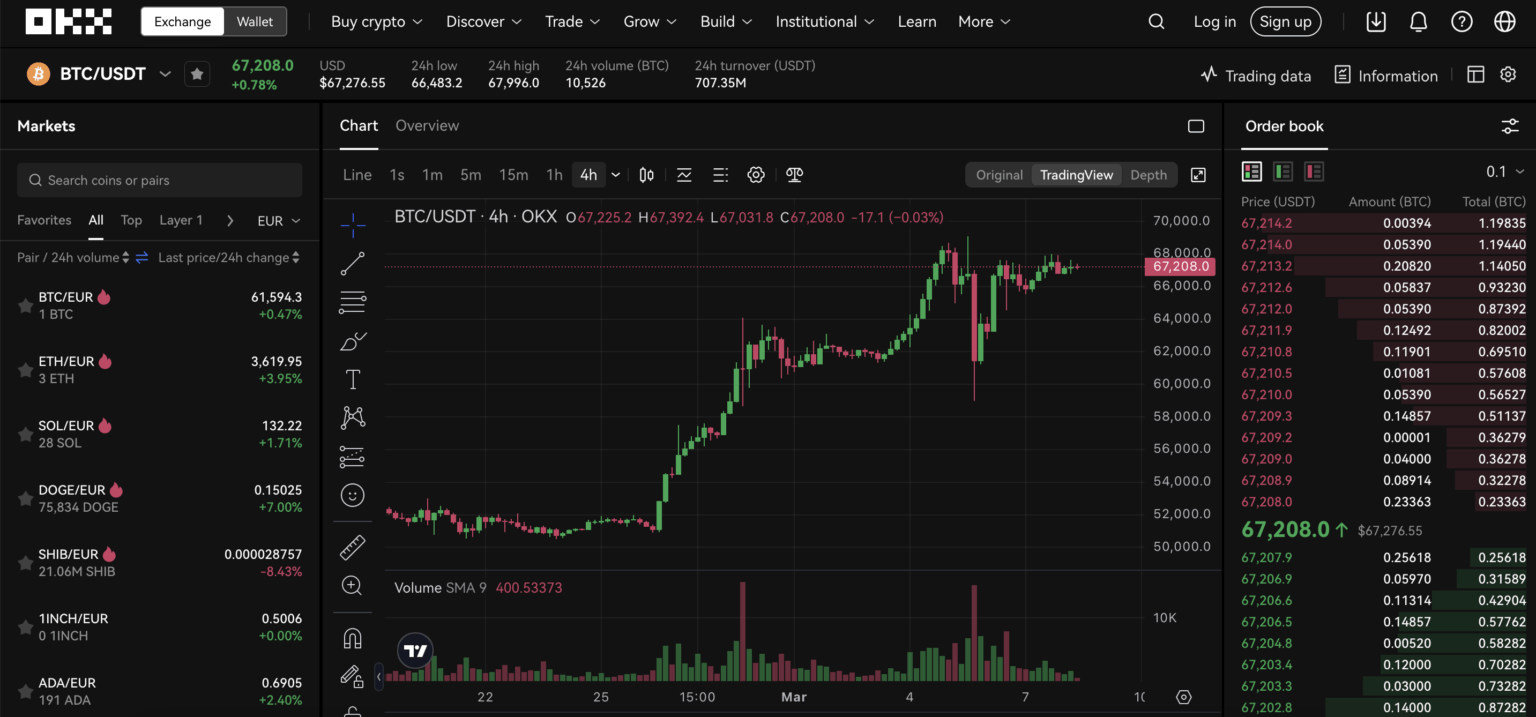
How the two access models work (mechanisms and immediate consequences)
At a basic level OKX exposes two distinct custody models behind the same brand: a centralized account where OKX holds custody and a self-custodial Web3 wallet where you hold the private keys. The centralized account requires account creation, KYC (government ID, facial liveness), and a password plus mandatory two-factor authentication (2FA). OKX claims military-grade encryption, AI-driven login monitoring, and stores over 95% of assets in multi-sig cold storage — mechanisms designed to prevent large-scale theft and to provide an on-ramps/off-ramps legal layer for U.S. customers.
The non-custodial Web3 wallet is different mechanically: you (or your hardware device) control the seed phrase and private keys. It integrates with DApps, supports Ledger/Trezor, and enables direct cross-chain interaction via the OKX DEX aggregator. Mechanically this removes exchange custody risk but introduces user custody risks: if you lose the seed phrase, there’s no centralized recovery; if you connect to a malicious site, smart-contract exploits can drain funds. These are mechanistic trade-offs — one reduces counterparty risk and regulatory friction; the other reduces self-custody risk and increases operational responsibility.
Side-by-side: Which mode fits each trading task?
Below I compare common trading activities and show where the centralized account versus Web3 wallet tend to be better fits. After each I add the decisive trade-off you should weigh.
Spot trading (rapid buy/sell of liquid assets): Centralized CEX is usually better. Mechanism: centralized order book, aggregated liquidity, low slippage on majors, and fast settlement within the exchange ledger. Trade-off: faster execution and margining versus counterparty custody and withdrawal delays when on-chain.
Margin and derivatives (futures, perpetuals, options): Centralized only. OKX supports up to 10x on margin and up to 125x in some futures products. These work through the exchange ledger and margin engines; you get features like isolated/cross margin but you accept forced liquidation mechanics enforced by the platform. Trade-off: leverage amplifies returns and risks; liquidation mechanisms are automatic and can produce losses beyond expected levels during flash moves.
DeFi yield farming, cross-chain swaps, and low-cap tokens: Web3 wallet + OKX DEX aggregator. Mechanism: the wallet signs transactions that interact with DEX smart contracts; the aggregator routes trades across liquidity sources to optimize price and cross-chain bridges. Trade-off: you avoid KYC for DeFi interactions and access more chains, but expose assets to smart-contract risk and potential bridge vulnerabilities.
Staking and managed yield: Mixed. OKX offers flexible and locked staking inside its CEX, with auto-compounding options. The Web3 wallet supports direct staking where you control keys. Trade-off: staking inside OKX is simpler and may be covered by the exchange’s custodial controls; outside staking gives custody but requires more operational knowledge and security practices.
NFT minting, buying and royalties: Web3 wallet is the principal route for minting and genuine on-chain ownership, but the OKX NFT marketplace links both models. Trade-off: centralized marketplaces can offer fiat rails and convenience; native ownership via wallet is stronger for long-term provenance.
Login and account protection: practical mechanics for U.S. users
When logging into a centralized OKX account in the U.S., the minimum protective stack you should treat as mandatory is: a strong password manager; hardware-backed 2FA (where available); device-level biometric only as a convenience layer (not the sole defense); and careful email hygiene to avoid phishing. Mechanistically, OKX ties login detection to AI-driven risk scoring — that helps detect anomalous sessions but cannot prevent credential compromise. So the user-side controls matter.
For the Web3 wallet, the core protective mechanic is the seed phrase and, ideally, hardware wallet integration. The practical rule: never paste or store seed phrases in cloud-synced notes; use a hardware wallet for routine high-value operations; treat the seed as the single source of truth. Unlike the CEX, there is no central customer service that can return funds if keys are lost.
Common myths vs reality
Myth: “An exchange with cold storage is immune to loss.” Reality: Cold storage reduces large-scale theft risk because withdrawals require multi-sig approvals, but operational security failures, insider risk, or poor multi-sig implementation can still lead to loss. Proof of Reserves (PoR) improves transparency by allowing on-chain verification of backing, but PoR does not eliminate operational risk or guarantee instant withdrawal if the exchange imposes limits.
Myth: “Using a Web3 wallet is automatically safer.” Reality: Self-custody removes counterparty risk but exposes you to permanent loss if you mismanage keys or sign a malicious contract. The safer path is conditional: for large, long-term holdings, custody + hardware wallet is often the superior risk-adjusted choice; for active DeFi strategies, accept operational risk but minimize it through hardware signing and limiting approvals.
What the recent delisting of several spot pairs signals
OKX recently delisted several spot pairs (RSS3, MemeFi, GHST, RIO, SWEAT). Mechanistically, delistings are routine liquidity and compliance maintenance: low-volume markets can create unpleasant execution risk and regulatory exposure. For traders this is a reminder: keep positions in thinly traded assets small, and prefer venues with higher liquidity if you plan to exit quickly. Delistings also create temporary price dislocations; if you own a delisted token you may need to move it to a DEX via your Web3 wallet or accept the longer withdrawal timelines from CEX custody.
Decision heuristics — a compact user framework
Here are reusable heuristics you can apply when deciding how to log in and which part of OKX to use:
– If you need fast execution, margin, or derivatives: use your verified centralized account and ensure 2FA and strong device security. Accept custody trade-offs.
– If you are interacting with DeFi, cross-chain bridges, low-cap tokens, or NFT minting: prefer the Web3 wallet with hardware signing and limit allowances.
– For long-term passive yield on majors: evaluate centralized staking for convenience and custodial protection versus on-chain staking if you prioritize self-sovereignty.
– Keep a split portfolio: a “hot” operational balance in the wallet for trades and farming, and a “cold” bulk balance in hardware or custodial cold storage depending on your trust model. This hedges both counterparty and self-custody failure modes.
Limitations, unresolved issues, and what to watch next
Limitations to be explicit about: first, regulatory change in the U.S. could shift product availability or KYC requirements quickly; the mechanism of compliance can alter liquidity and the cost of services. Second, Proof of Reserves improves transparency but is not a substitute for operational audits or insurance — it confirms backing on-chain at snapshot times, not continuous solvency under stress scenarios. Third, cross-chain bridges and DEX aggregators introduce complex composability risk: using multiple protocols increases attack surface and interdependency.
What to monitor: changes in leverage rules or permissible products for U.S. customers; updates to OKX’s cold storage or multi-sig architecture; and third-party audit disclosures about the DEX aggregator and bridge security. If you trade newly listed or delisted assets, watch order-book depth and recent trade volume rather than relying on token market cap alone.
Frequently Asked Questions
Q: Can I use my OKX centralized account and Web3 wallet interchangeably?
A: You can move assets between them, but they are different legal and operational models. Transfers from the centralized account to the wallet are withdrawals that pass through exchange withdrawal controls and on-chain settlement times; transfers back require deposit processing. Treat them as two separate custody domains with distinct recovery and risk profiles.
Q: What login method is safest for a U.S. day trader?
A: For active day trading—particularly when using margin or futures—the typical safe choice is a verified CEX account with strong 2FA and device security. The exchange provides rapid order execution and ledgered margining. But pair this with smaller on-exchange balances and keep larger holdings in cold or self-custodial storage.
Q: How do delistings affect my strategy?
A: Delistings reduce liquidity and may leave you with assets that are harder to exit on the exchange. Mechanically, you may need to withdraw to a Web3 wallet and trade through a DEX. The decision rule: always size positions in low-volume tokens assuming you might need off-exchange routes to exit.
Q: Is OKX’s Proof of Reserves sufficient to trust the exchange?
A: PoR improves transparency by letting users verify on-chain reserves, which is a strong signal of backing. However, PoR is a snapshot-style transparency mechanism and does not remove operational or legal risks. Use PoR as one indicator among several (audits, insurance, multi-sig cold storage practices) when assessing counterparty risk.
Final practical note: if you’re ready to proceed to the platform and learn the specific login flows, the OKX sign-in and wallet pages explain the step-by-step process for both custody models and associated security settings; you can begin that journey here: okx. Use the heuristics in this article to choose which access model matches your immediate trading goal, and remember: speed and convenience often cost you control or expose you to different classes of failure—so make that trade-off deliberately.
